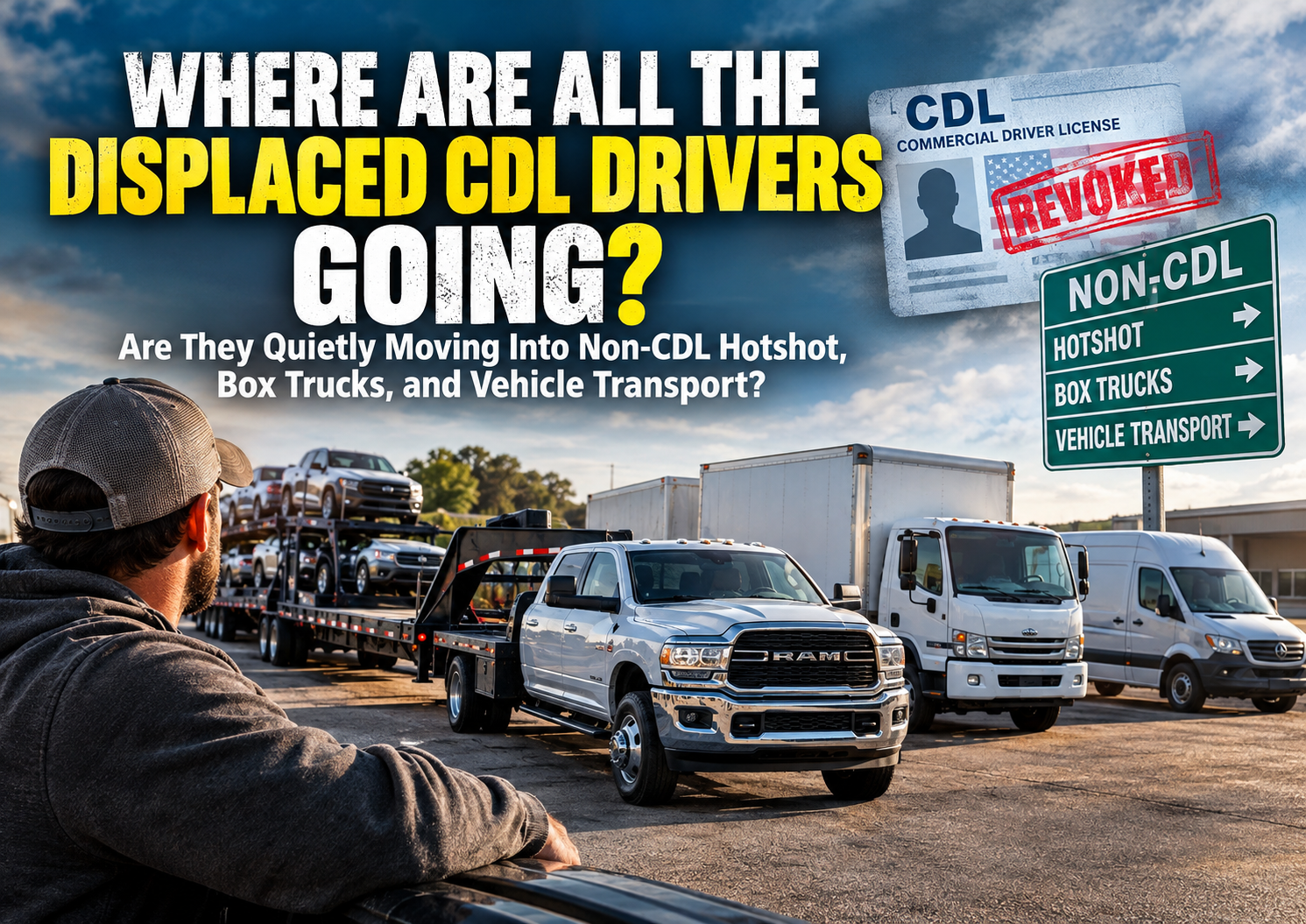
Displaced CDL Drivers: There are literally hundreds of Spanish-speaking carriers out there that could lease these drivers on. And plenty of displaced drivers won’t wait to be leased on at all. They’ll buy a pickup, hook up a gooseneck, and become owner-operators themselves.
We don’t say that from behind a desk. We manage several trucking groups, including Texas-based communities, and we keep a close eye on one of the largest Spanish-language hotshot groups in the country, Hotshot Trucking Español.
We see the recruiting posts. We see the lease-on offers. We see the demand for Spanish-speaking non-CDL drivers. And vehicle transport is where I’m seeing the most action right now.

So let me ask the question I think this whole industry should be asking:
Are drivers who lose their CDLs actually leaving trucking, or are some of them just moving down to non-CDL operations?
FMCSA Saw This Coming
In its February 13, 2026 final rule on non-domiciled CDLs, FMCSA openly acknowledged that drivers who lose eligibility for those licenses may find other transportation work, including: “driving vehicles that do not require a CDL.”
Read that again. The federal regulator itself expects some of these drivers to land in non-CDL work. And don’t forget how this works. FMCSA doesn’t pull CDLs directly. The individual states issue, downgrade, and revoke them under the federal framework.
FreightWaves Pulls Back the Curtain on “Ghost Fleets”
On June 1, 2026, FreightWaves published an investigation called Inside Hotshot Trucking’s Ghost Fleets.
Here’s what jumped out at me:
• 32 auto-transport carriers reported just 38 power units combined
• Inspection records tied more than 6,000 unique vehicles to that same network
• Investigators found hundreds of CDL-related and English-language proficiency violations
Thirty-eight trucks on paper. Six thousand on the road. That math doesn’t work, and everybody in this business knows it.
Now, to be fair, the article doesn’t prove those operators were drivers who had their CDLs revoked. But it does show the industry is drifting toward hotshot and auto transport as enforcement tightens, and it raises serious questions about carrier accountability in parts of the vehicle-transport world.
The Other Reports Line Up
FreightWaves isn’t the only one connecting these dots.
• Shaker Logistics wrote about how the non-domiciled CDL crackdown will hit freight, and pointed straight at Sprinter vans and smaller non-CDL box trucks as alternative options for shippers.
• The Houston Chronicle reported this month that more than 6,400 Texas drivers had lost commercial driving privileges by late June. One former truck owner who ran both an 18-wheeler and a box truck ended up delivering Amazon packages after losing her CDL.
• Overdrive has documented state after state downgrading non-domiciled commercial licenses.
So here’s what we know for sure: drivers are being displaced, and some of them are finding other ways to stay behind the wheel. What nobody has nailed down yet is how many are ending up in non-CDL hotshot or vehicle transport.
Here’s What a Lot of People Are Getting Wrong
Non-CDL does NOT mean non-DOT.
Plenty of non-CDL hotshot combinations, commercial box trucks, and car haulers are still fully subject to FMCSA regulations. That includes 49 CFR § 391.11(b)(2), the English-language proficiency requirement for drivers covered by the federal qualification rules.
You don’t escape the rules just by trading an 18-wheeler for a dually and a gooseneck.
And let me be crystal clear about something else. Speaking Spanish, or driving for a Spanish-speaking carrier, does not mean a driver fails the English-language standard. I know a lot of bilingual operators who are sharp, legal, and fully compliant, and they’re some of the best people in this business.
This was never about language or where somebody comes from. It’s about whether every person running a commercial vehicle is properly qualified, properly insured, and playing by the same rules as the rest of us.
And Yes, You Can Still Get Parked on the Side of the Road
One of our group members brought up a point that needs to be said loud: losing your CDL doesn’t get you out of an English-proficiency check, and failing one can still put you out of service on the spot.
He’s right. Here’s how it works.
Since June 25, 2025, a driver who can’t meet the English-language proficiency requirement in 49 CFR § 391.11(b)(2) gets placed out of service under the CVSA North American Standard Out-of-Service Criteria. That means the truck stops right there, and the driver can’t legally operate a commercial motor vehicle until the problem is fixed.
The check itself is simple. The inspector conducts the interview in English and expects English answers. No interpreters, no translation apps, no cue cards. If the driver gets through that, the inspector can also test whether he understands U.S. highway signs.
Now here’s the part that matters for our side of the industry. That rule covers drivers of commercial motor vehicles in interstate commerce, and under the federal definition that starts at 10,001 pounds. Most hotshot rigs, a dually pulling a loaded gooseneck, blow right past that number. No CDL required. Still a commercial motor vehicle. Still subject to the English rule.
And this isn’t just paper enforcement:
• DOT reported roughly 9,500 drivers placed out of service for English proficiency in 2025 alone.
• During International Roadcheck 2026, 361 drivers were put out of service for English-proficiency violations, about 9% of all driver out-of-service orders. It ranked fourth, and it didn’t even crack the top five the year before.
So if someone loses a CDL for reasons tied to this crackdown and drops down into a non-CDL hotshot or car-hauling setup, the same inspector can park him on the same highway for the same reason. And the carrier who put him in that truck gets the violation on its record.
Carriers, hear me on this. Leasing on a driver who can’t communicate in English isn’t a loophole. It’s a liability waiting for a scale house.
Hotshot-USA’s Take
After years of running trucking communities and working shoulder to shoulder with owner-operators, fleet owners, and carriers, I’ve learned one thing:
The trends show up in the trucking groups long before they show up in the government statistics.
And right now, I’m seeing enough to believe this deserves a much closer look, especially in vehicle transport.
I’m not saying every displaced CDL driver is jumping into hotshot. I’m not saying every new operator out there is breaking the rules. But look at what we already know:
✅ FMCSA itself expects displaced drivers to look for non-CDL work.
✅ States are actively downgrading commercial licenses.
✅ Industry publications are pointing shippers toward smaller trucks.
✅ FreightWaves exposed serious compliance problems inside an auto-transport network.
✅ Roadside inspectors are already parking thousands of drivers who can’t pass the English check, CDL or not.
Put that together and you get the real question:
Is the crackdown on CDL drivers just pushing the same problems down into the non-CDL side of trucking?
That’s the question. And legitimate hotshot operators, fleet owners, brokers, and regulators had better be paying attention, because we’re the ones who’ll be competing against it, insuring around it, and cleaning up after it.
Run your business like a business. Stay compliant. And don’t let anybody drag this segment’s reputation through the mud.
I’ll keep tracking this through the Hotshot-USA Resource Network.
Now We Want to Hear From You
What are you seeing in your area? Are former CDL drivers showing up in non-CDL hotshot, box-truck, or vehicle-transport operations?
I especially want to hear from carriers with firsthand experience. Drop it in the comments. Knowledge is power, and this industry needs the truth from the people actually out there running it.
CLICK HERE TO READ MORE HOTSHOT RELATED ARTICLES!