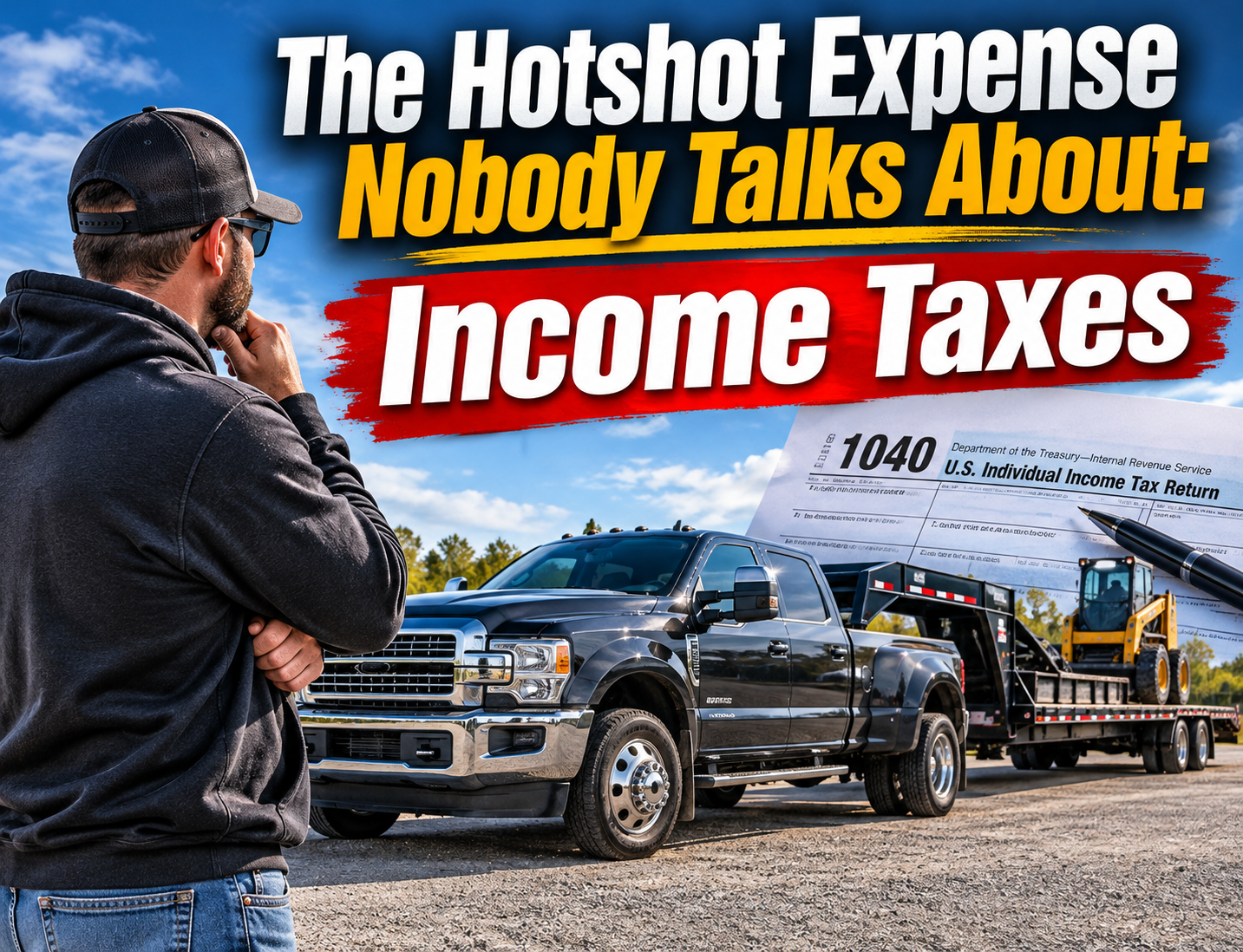
Income taxes – We’ve been running hotshot trucking groups and working as an owner-operator for a long time, and this one subject still catches me off guard — how little anybody talks about it.
We’ll burn a hundred conversations on rates. We’ll argue CDL versus non-CDL, insurance costs, fuel prices, brokers, factoring, dispatchers, truck payments, trailer prices, tires, maintenance, and whether a man can make it on $1.80 a mile.
But how many times have you seen somebody ask: “How much are you setting aside for taxes?” I can count on one hand the real conversations I’ve seen about it in our trucking groups over the years.

And taxes might be one of the biggest expenses an owner-operator carries.
Gross Revenue Is Not What You Made
Here’s the mistake I see new owner-operators make over and over.
They look at the settlements hitting the bank account. Maybe the truck grossed $150,000. Maybe $200,000. Maybe somebody gets on Facebook and announces he “made $250,000 trucking last year.”
No. The business grossed $250,000. What you made is a completely different number.
Fuel comes out. Insurance comes out. Truck and trailer expenses come out. Repairs, tires, maintenance, permits, tolls, factoring fees, dispatch fees, ELD expenses, compliance costs, equipment, interest, and a dozen other legitimate business expenses come out.
Then — and only then — you land on your business profit. And Uncle Sam wants a piece of that number.
That’s why bookkeeping isn’t something you start thinking about in March or April when somebody asks for your records. Bookkeeping is part of running the truck.
Run your business like a business. That includes the parts you don’t want to look at.
The 1099s Don’t Just Disappear
Here’s the part people forget. When a broker or company pays you and files a 1099-NEC, that same form goes to the IRS. Their system automatically checks what you reported against what those 1099s say. Mismatch, and you get a CP2000 notice proposing more tax owed — straight from the IRS’s own matching system.
So ignoring your taxes doesn’t make the income disappear. That record is sitting in their database whether you look at it or not.
The longer you go without real bookkeeping, the harder it gets to reconstruct what actually happened. You might know you spent tens of thousands keeping that truck on the road. The question is — can you prove it?
There’s a big difference between telling the IRS “I spent a bunch on my truck” and handing them organized records showing exactly what you spent, when, and what it was for.
Owner-Operators Have Another Tax Many Employees Never Think About
A regular employee has Social Security and Medicare taken out of every paycheck, and the employer covers half. An independent owner-operator doesn’t get that luxury — you’re on the hook for self-employment tax, both halves.
The federal self-employment tax rate is 15.3%: 12.4% for Social Security, 2.9% for Medicare, applied to 92.35% of your net self-employment earnings, subject to the Social Security wage limit and a few other rules.
That’s on top of your regular federal income tax. Sit with that for a second.
Here’s what it looks like in real dollars — before your regular federal income tax, credits, entity structure, or state taxes even enter the picture:
• $50,000 in Schedule C net profit: roughly $7,065 in self-employment tax alone.
• $75,000: roughly $10,597.
• $100,000: roughly $14,130.
• $150,000: roughly $21,194.
And I’ll say it again — that’s not your total tax bill. That’s just the self-employment tax piece.
Your actual bill depends on filing status, other household income, deductions, credits, your business structure, and a handful of other variables. Which is exactly why I don’t tell truckers there’s some magic “average” tax bill every owner-operator pays. There isn’t. Two drivers can gross the identical number and owe completely different amounts.
This Has to Be Figured Into Your Cost of Doing Business
Here’s where I think this industry does new people a disservice.
Guys calculate: truck payment, $1,500. Trailer, $800. Insurance, $2,000. Fuel — whatever she burns. Maintenance — maybe ten, fifteen cents a mile. Then they run a break-even rate off all of that.
Where are the taxes?
If your business is actually profitable, part of that profit already has somebody else’s name on it. That money isn’t sitting there for a down payment on another truck, new rubber, a vacation, or whatever you had planned for it.
One of the worst things an owner-operator can do is look at $20,000 sitting in the business account at year-end and think every dollar of it is his. Some of it already belongs to Uncle Sam. You just haven’t sent it yet.
And Waiting Until April Doesn’t Necessarily Work
The U.S. runs on a pay-as-you-go tax system. If you’re self-employed and expect to owe at least $1,000 after withholding and credits, the IRS wants estimated payments made throughout the year — not one lump sum in April.
In other words, “I’ll figure it out at tax time” isn’t a strategy. It’s a gamble.
A real strategy means knowing, month to month, roughly what your business is earning, what you can legitimately deduct, and what you’re going to owe. That takes bookkeeping.
Not a shoebox of fuel receipts. Not scrolling through twelve months of bank statements the weekend before your appointment. Actual bookkeeping.
Good Recordkeeping Can Save You Thousands
Now, I’m not telling you to hand over 30% of everything you gross. Absolutely not.
A legitimate trucking company has legitimate expenses. Fuel, repairs, tires, commercial insurance, permits, tolls, factoring charges, dispatch fees, ELD costs, accounting and tax prep, business communications, equipment, and depreciation on your truck and trailer can all knock down your taxable profit when they qualify.
Here’s one a lot of guys don’t know: if you’re an interstate driver subject to DOT hours-of-service rules, the IRS lets you deduct 80% of qualifying business meals while you’re away from your tax home — not the standard 50% everybody else gets.
That’s exactly why having a tax pro who actually understands transportation matters. You’re not trying to hide income. You’re making sure every legitimate deduction the law allows actually gets taken.
There’s a world of difference between tax avoidance through smart, legal planning and tax evasion. One is smart business. The other can end your business.
What Happens When You Don’t Pay Income Taxes?
As of 2026, the IRS failure-to-file penalty runs 5% of the unpaid tax for every month — or part of a month — your return is late, up to 25%. The failure-to-pay penalty adds another 0.5% a month, up to another 25%, and that monthly number climbs higher if you ignore collection notices.
Then there’s interest. For the third and fourth quarters of 2026, the IRS is charging 7% annually on underpayments, compounded daily, and that rate resets every quarter — it can go up just as easily as down.
That’s how an old tax bill turns into a much bigger problem than the original bill. It doesn’t sit there waiting on you. Penalties and interest keep working while you’re asleep.
Eventually it stops being an accounting problem. The IRS can file a federal tax lien against your property. After the required notices, they can levy your bank accounts, garnish income, and — yes — seize and sell vehicles or other assets to collect what’s owed.
Think about what that means for you specifically. Your truck isn’t just a truck. It’s how you eat. Tax problems can become business-survival problems, fast.
If You Can’t Pay, Don’t Hide From It
This might be the most important thing in this whole article.
Not being able to pay the full bill is not the same as refusing to deal with it. The IRS itself says: file on time even if you can’t pay in full. Payment plans and installment agreements exist, and with an approved installment agreement, your failure-to-pay penalty can drop to 0.25% a month.
Skipping the return because you don’t have the money doesn’t solve one problem — it creates two.
File. Communicate. Get professional help. Make arrangements. Don’t throw those letters in the glove box and hope they go away.
Taxes Need to Become Part of Your Weekly Business
If I were starting a hotshot company today, taxes would be built into the operation from the very first settlement. I’d keep separate personal and business accounts and real books from day one — not a mental tally. I’d track every legitimate expense and keep the documentation as I went, instead of trying to rebuild a year of it later. I’d have a tax professional who actually knows this industry estimate my federal and state liability and tell me exactly how much of each settlement to set aside. I’d move that tax money into its own account and treat it like it isn’t mine — because it isn’t. And I’d review profit, expenses, and estimated taxes all year long instead of finding out the answer after the year’s already over.
The percentage won’t be the same for everybody. That’s exactly why you need somebody looking at your actual numbers, not a rule of thumb from a Facebook group.
We Need to Start Talking About This
We talk nonstop about people getting into this industry without enough money. We warn them about breakdowns. We warn them about $4,000 insurance down payments, $1,500 tires, $8,000 transmissions, $15,000 engines, and losing a week of revenue while the truck sits in the shop.
But there’s another bill quietly stacking up while that truck is running perfectly fine.
Taxes.
Doesn’t matter if you’re running one truck or twenty. You’re operating a business, and the money crossing your settlement sheet is not the same thing as money you get to keep.
Know your numbers. Keep your books. Document your expenses. Take every legitimate deduction you’re entitled to. Plan for the tax bill before you spend the money. And if you’re already behind, deal with it now instead of letting it ride another year.
Because in this business, plenty of things are already out of our control. Fuel goes up. Rates go down. A transmission can let go tomorrow. A broker can cancel a load without warning. Insurance jumps at renewal.
But getting blindsided by years of unpaid income tax? That’s one business emergency you can see coming from a mile away.
Knowledge is power. Use it. Drive safe. Secure your loads. Go home.
INTERESTED IN MORE HOTSHOT RELATED ARTICLES? VISIT OUR RESOURCE BLOG!