

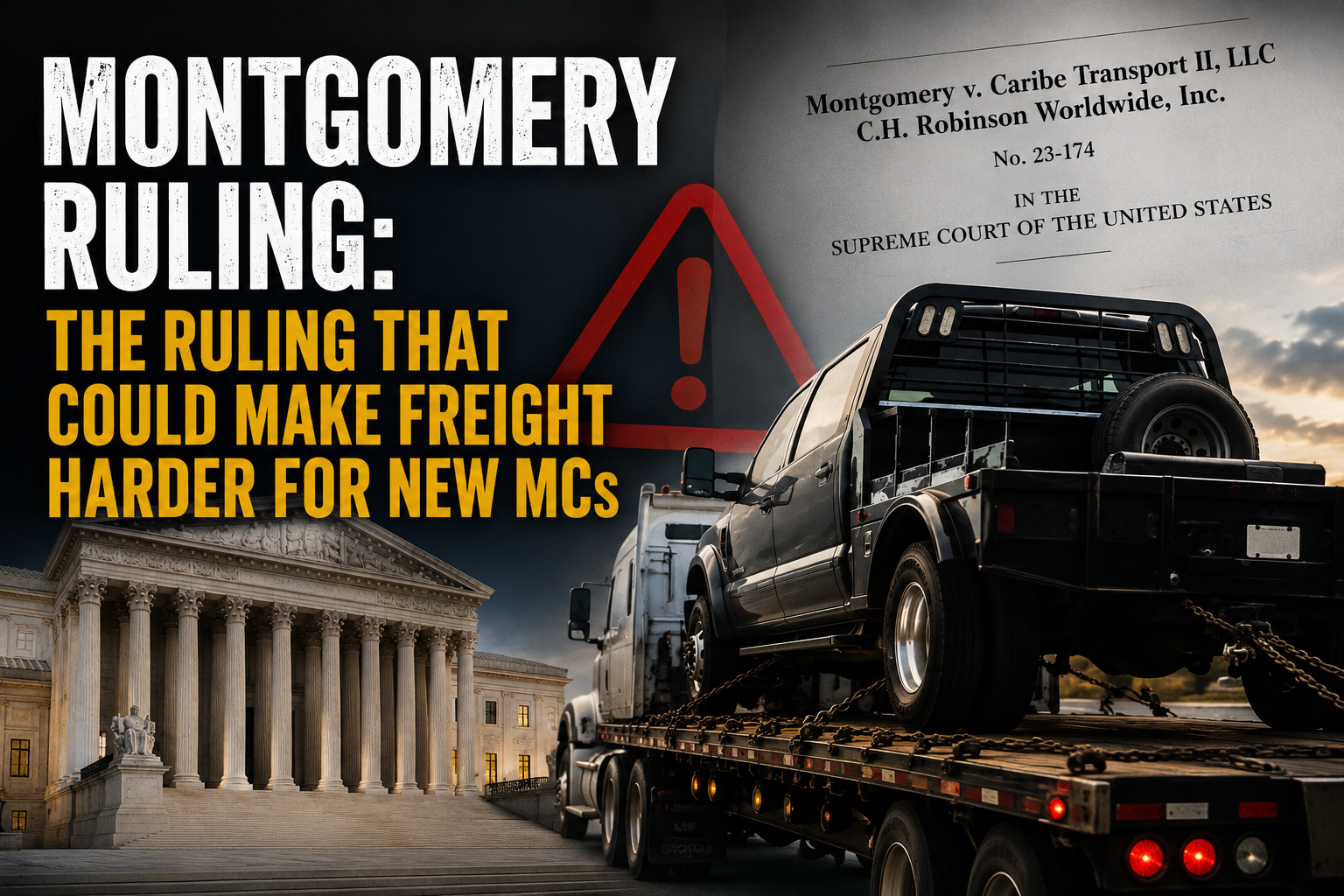
Montgomery Ruling: A lot of new carriers think the hardest part of getting into hotshot trucking is buying the truck, getting the trailer, filing for authority, buying insurance, and finding that first load. After the Montgomery v. Caribe Transport II / C.H. Robinson Supreme Court ruling on May 14, 2026, it is even less true than it was before.
What the Court Actually Said
The Supreme Court did not say every broker is automatically liable for every carrier they hire. What they said is that negligent-hiring claims against freight brokers are not automatically blocked by federal preemption when the claim involves highway safety. In plain English — if a broker hires a carrier with obvious safety problems and that carrier is involved in a serious crash, the broker may have to answer for how and why that carrier was selected. That is a big deal.
For years, brokers leaned on federal transportation laws to shield themselves from certain state-law negligent-selection claims. Montgomery knocked that shield sideways. Now the spotlight is on the process.

Did the broker check the carrier’s authority? Verify insurance? Look at the safety record? Ignore red flags? Follow a consistent vetting policy? Document the decision? That is where this industry is headed. And if you are a new carrier, you better understand what that means for you.
Montgomery Ruling: The Broker’s New Problem
Brokers still have freight to move. Shippers still want capacity. Customers still want lower rates and faster service. But now brokers have a legal-risk question hanging over every single carrier they select. If a crash happens, the question may no longer be, “Was the carrier legally authorized?” The question becomes: Was this carrier a reasonable and defensible choice at the time the load was tendered?
That is why enhanced carrier vetting is not just a trend anymore. It is becoming part of the broker’s liability defense.
Here is what that means in the real world. A broker may need to show they checked active authority, verified insurance, reviewed safety data, screened for fraud, looked for chameleon-carrier patterns, confirmed identity, and followed their own internal standards.
And here is the part that a lot of carriers miss completely: A broker’s own rules can become evidence.
If a broker says they require certain safety checks, insurance minimums, MC age, tracking, or documentation, they better follow those rules consistently. Because the one time they make an exception could be the one load that gets picked apart in a courtroom.
That is why you are going to see more questions, more verification, more tracking requirements, more documentation demands, and more rejections. Not because brokers hate new carriers. Because brokers are trying to protect themselves.
New MCs Are Not Banned — But the Room Got Colder
Let me be clear about something. There is not yet a mass public announcement from every major broker saying they are raising MC-age requirements because of Montgomery Ruling. I have not seen a big broker come out and say, “Because of this ruling, we are going from 90 days to 6 months or 1 year.” But that does not mean the pressure is not real.
MC age was already a screening factor before the montgomery ruling. A lot of brokers already looked at whether your authority was brand new, 30 days old, 90 days old, or a year old. Some would work with new MCs. Some would not. What Montgomery does is give brokers another reason — and now a legal one — to be more cautious.
New MCs are not banned. But you are walking into a colder room. After this ruling, brokers have more reason to ask: How old is the authority? How many inspections does this carrier have? Any out-of-service issues? Any insurance lapses? Any FreightGuard reports? Any Carrier411 flags? Does the phone number match FMCSA? Does the email match the carrier? Does the carrier’s address make sense? Does the driver match the company? Is the equipment actually theirs? Will they accept tracking? Can they prove they are not double brokering? Can we defend using this carrier if something happens?
That is the real-world impact right there. It may not show up as one clean public announcement. It shows up as more rejected packets, more unanswered emails, more tracking requirements, more identity verification, more broker portals, more Highway checks, more RMIS reviews, more insurance scrutiny, and more “Sorry, we can’t use you yet.”
 This Is Bigger Than MC Age
A lot of new carriers hear “your authority is too new” and that becomes the whole story for them. But MC age is only one piece of the bigger picture.
A 2-year-old MC with bad inspections, insurance problems, fraud reports, poor communication, and safety red flags may be more dangerous to a broker than a 90-day-old MC that is clean, documented, properly insured, responsive, and professional.
The problem is that a new MC usually has very little data. No inspections. No broker history. No shipper references. No track record. No pattern of performance. No safety history to evaluate. To a broker — especially a post-Montgomery ruling broker — that looks like risk. And risk now has legal teeth.
The broker is not just trying to fill a truck anymore. They are trying to protect the shipper, the load, the customer relationship, the insurance file, the legal file, and their own company. That is why cheap rates do not always win. Sometimes cheap freight becomes expensive in court.
The Digital Gatekeepers Now Matter More Than Ever After Montgomery Ruling
The old-school way was simple. Call the broker. Negotiate the rate. Send the packet. Pick up the load. Deliver. Get paid. That world is fading fast. Now there are digital gatekeepers sitting between you and the freight. Carrier411. Highway. RMIS. MyCarrierPackets. FMCSA Licensing and Insurance. Insurance databases. Tracking platforms. Broker internal scoring systems. Fraud-prevention tools. Identity verification. Phone verification. Email-domain checks. ELD and GPS data. Broker notes and internal DNU lists.
This is the new carrier compliance ecosystem. And whether you like it or not, this is how freight is being filtered now. A new carrier might think, “I have insurance and authority, why won’t brokers load me?”
Because brokers are no longer only asking whether you are legal. They are asking whether you are safe, legitimate, trackable, insurable, verifiable, and defensible. That is a much higher bar than it used to be.
What This Means for You as a Hotshot Carrier
Your MC number is not just a number. It is your reputation file. Every inspection matters. Every out-of-service violation matters. Every insurance lapse matters. Every bad broker interaction matters. Every missed appointment matters. Every tracking refusal matters. Every shady dispatcher representing you matters. Every bad phone number, mismatched email, fake address, or sloppy packet can cost you freight.
You are not just building a trucking business. You are building a digital trust profile. And in the post-Montgomery Ruling world, that profile is everything.
What New Carriers Need to Do Right Now
Do not panic. But do not be naïve either. Build your authority like you are building a credit file. Protect it like it is money in the bank. Because it is. Keep your insurance active. Keep your FMCSA information clean and accurate. Answer the phone professionally. Use an email that matches your business. Make sure your dispatcher is not making you look suspicious. Do not let foreign-based scammers, fake dispatchers, or lane sellers represent your company.
Do not double broker. Do not haul under someone else’s MC in a messy setup. Do not change phone numbers and addresses every few weeks. Accept reasonable tracking. Keep your equipment clean and inspection ready. And protect your safety record like your business depends on it. A clean inspection builds credibility. A bad inspection follows you into broker systems faster than you think.
Brokers are going to protect themselves. Some will raise MC-age requirements. Some will require more inspections. Some will lean harder on Highway, RMIS, Carrier411, or internal vetting tools. Some will require live tracking on more loads. Some will refuse carriers with weak safety profiles. Some will update contracts and indemnification language. Some will get stricter on insurance. Some will stop making exceptions for new or questionable carriers.
The freight market was already moving toward more scrutiny because of fraud, double brokering, cargo theft, nuclear verdicts, insurance pressure, and shipper risk. Montgomery did not create all of that by itself. But it poured gasoline on it.
The Bottom Line After Montgomery Ruling
Montgomery is not the end of freight brokerage. It is not the end of new MCs. It is not the end of hotshot trucking. But it is another sign that the modern market has changed. The old days of “I got authority, I got insurance, give me a load” are done.
The new question is: Can this carrier be trusted, verified, tracked, insured, and defended? That is the post-Montgomery standard. For new carriers, the room just got colder. Not impossible. Just colder.
The carriers who understand this will adjust. They will clean up their paperwork, protect their inspections, communicate professionally, avoid shady dispatchers, maintain their insurance, accept tracking, and build a reputation that brokers can defend.
The carriers who ignore it will keep blaming brokers, load boards, dispatchers, and the market — while their MC slowly gets pushed to the outside. This is the modern hotshot business now. Old School Built It. New Rules Run It.
Want to go deeper?
Everything I just told you in this article — the history, the changes, the real truth about where this industry is headed — I have been living it, driving it, and documenting it for years. I am talking about the full story. Where hotshot trucking came from. How it grew. Why the rules keep changing. What the modern market really looks like from behind the wheel and from the business side. And what it is going to take to survive and thrive in it going forward. I wrote it all down.
Hotshot in the USA — The Truth About the Modern Hotshot Market is coming soon from the Hotshot-USA Resource Network. This is not a YouTube video. This is not a Facebook post. This is the real book, from a real driver and business owner who has been in the trenches of this industry and watched it change from the ground up.
If you want the knowledge. If you want the edge. If you want to run your business like a business — this is the book you have been waiting for. Coming Soon





Another spot on article and as a new DOT and carrier but with 42 years very well documented in the industry and VP or Risk Management for a carrier that specializes in OSOW and Flatbed this is the best time to have a new gig. Public safety is number one and so is compliance and those good old days have been long gone and is very well missed but most of us veterans. Being a JD, and refusing offers to represent against the industry my family groomed me to be in and if it as a CDL driver or in house council or a Safety Manager, all are unfortunately liable for these bad players. Don’t be afraid to be new, but be sure you are not pencil whipping things and seek assistance and let’s all stop the crashes, one state after another and crash at a time and be safe.
Thank you for your insight!